|
|
 |
Want better performance from your older Triumph, BSA, Norton, Royal Enfield, AJS, Velocette, Ariel or Matchless single or twin? Already have Amal carburetors, but don’t know how to adjust them? Doesn’t run “right”, and won’t respond to the changes you’ve made? Can’t get the information you need from the original instructions (even the very useful Coventry Spares, Ltd.’s “Tuning Your Carburetor: Amal - The Basics”)?
Perhaps you're preparing a vintage racer for AHRMA, etc. and are required to use the Monobloc by class rules. How to give your bike a competitive advantage? Try out that new megaphone? Get more air-flow from the original small carburetor? You don’t just want this booklet - you need it. My booklet includes specific choices of carburetor size and starting points for jetting the most common engine displacements (not brands or models), giving you something you can really use, along with many helpful hints, comments, observations, data, etc.
Amal Monobloc carburetors have been used successfully on British motorcycles beginning in 1955. I’ve learned how to adjust and tweak them on older British engines (beginning with my own 1966 Triumph Thunderbird), including the BSA Gold Star, Lightning Rocket, Thunderbolt, Hornet, Cyclone, Victor, Shooting Star; Triumph T120 Bonneville, Trophy, Tiger, T100, 3TA, 5TA, TR6, T90, 6T; Norton 88, 99, Dominator, Atlas; Ariel; Royal Enfield Constellation, Bullet, Interceptor; Velocette Venom, Thruxton and more 250, 350, 500 & 600cc singles and 350, 500, 650 & 750cc twins, both pushrod OHV and side-valve. | |
|
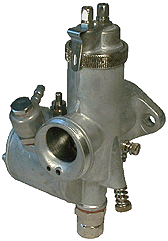
All sizes of this type have very similar component functions. The commentary in my booklet is limited to the twelve largest and most common Amal Monobloc carburetors: Type 389 (13/16”, 15/32”, 11/8”, 13/32”); Type 376 (11/16”, 1”, 15/16”); & Type 375 (7/8”, 13/16”, 25/32”, 23/32”, 21/32”). |
Which is which? The Monobloc is original equipment for most British models from 1955-1967 (except for some high-performance specials such as BSA Gold Star and Spitfire). The newer “Concentric Mark I” was original equipment for some British models beginning in 1967, and almost universal from 1968 into the middle 1970’s when it was superceded by the Mark II. I offer a separate booklet for the Concentric Mark I:  . .
For those with older (pre-1955) machines equipped with the remote-bowl “Standard” Type 276, 289 or special (6, RN, 27, “TT” & “GP”) the commonality of component design and function between these and the Monobloc (their descendant) makes much of the tuning and modification material in my book generally applicable, but I’m not sure what percentage of the mixture is controlled by each successive circuit (vs. Monobloc) or the degree of function overlap. The sequence of circuit activation and general tendencies should be very similar, but no specific references are made.
Click here to down-load the original Amal factory booklet for the Standard: , “TT”: , or “GP”: carburetors.
I can’t include instructions for your motor - there are too many variables - but the bike will definitely start, idle, run acceptably with good throttle response, and allow you to make those final adjustments to get it running really sweet.
This is not the “generic” instructions or re-print of 40 year old Amal factory material you've already seen on-line (click for more information here: ) but begins where they leave off, and goes beyond into fine tuning, demon tweaks and mods. Some of this information has been previously available from other sources, but is comprehensive and co-ordinated here to be more helpful and instructive. Explains and compares differences in components and function between the Monobloc & Concentric carburetors, which parts can be interchanged and why. Not an expert mechanic? You’ll still find this useful to identify what adjustments and parts you need. All parts are easily available all over the world at reasonable prices. If you’re using an Amal carburetor, you should read my booklet.
I guarantee that you’ll find information in my booklet you’ve never seen before, and which will help you plan and complete your carburetor installation and adjustments.
Consider this: if my booklet saves you from making even a single mistake or bad purchase, or gives you one new idea, doesn’t that make this purchase worth while? The price is a small fraction of what you have invested in the carburetors, let alone the classic motorcycle itself - plan more intelligently, and get better results.
This booklet is stapled in paperback to save printing costs, and includes all the following subjects in 50 pages (over 38,000 words), with over 25 black & white illustrations & diagrams, plus 35 data tables:
How the Monobloc works; an in-depth examination of how the different circuits operate, exactly
what each component does, how to interchange parts and make adjustments, explained in
much more detail than the factory service bulletins.
Tuning components; which internal parts can be adjusted or substituted to change mixture.
Needles sorted by Type & marking; which needles are used in which carburetor and why.
How to test and adjust mixture using a vacuum gauge.
Adjusting mixture for hot cams, alternate exhaust systems; including TT pipes, megaphones,diagnosing and correcting mixture based on symptoms.
Setting up a new carburetor.
Dynamometer testing; how to prepare.
Velocity stacks and ram tubes; how they work, which ones are best.
Tuned length intake manifold; how to make calculations for more power, including 5 Tables
of pre-set manifold lengths based on cam duration, RPM, etc.
Tunnel-ram intake manifold; more power for single-carburetor racers with theory, calculations
and dimensions,
including illustrations and 2 Tables of pre-set data.
Tuned “Helmholtz” resonator; add an air box for power, discusses theory, calculation
and dimensions,
including 5 Tables of pre-set data.
Alternate slide & needle jet sizes; more choices than factory to set mixture more closely.
Advanced speed tuning; any Amal carburetor can be fine-tuned for more air-flow, more accurate
jetting and better performance with these modifications and adjustments.
Remote float bowl; how to adapt a bowl from another source for added fuel capacity and “classic” appearance.
Carburetor selection; explores possible alternate choices of Type and size, depending on your
engine, displacement, head, intake manifold, cam timing, etc.
Dual carburetor conversion; how to convert your single-carburetor twin (TR6, &c.) to dual
carburetors, size selection, what parts are needed for your current carburetor, how to makeyour own individual manifolds from common materials.
Air cleaner; how to modify & improve the air cleaner for more air flow,while retaining stock appearance.
Jetting tables; specific trial (initial starting point) jetting suggestions for motors based on
displacement, single or twin cylinder, single or dual carburetor(s), carburetor size and type
(87 entries for single carburetor,
43 entries for dual carburetors).
Converting the Monobloc to alcohol; discusses jetting changes, advantages, maintenance, safety.
Please note: this is not a coffee table book, it is intended to be a research tool for those who seriously want to improve their Amal Monobloc carburetors. This is not a repair manual. If your bike won’t start, float bowl leaks, spark plugs foul, &c. my booklet will not help you. It don’t contain information on tune-ups, or explain how to remove, disassemble or clean the carburetor. It does not identify the “build number” for your specific engine, or list the original components used in a specific carburetor. If you don’t already have this information do not buy this booklet. If your engine is nearly stock and you’re pleased with how it runs now, this booklet is not going to be of much use, although you might find it interesting. |
My booklet is absolutely not the same as (or even similar to) the “tuning guides” you may have seen described as “Complete tuning and troubleshooting guide”, the most common one is “Hints and Tips For Amal Monobloc Carburetter, Types 375, 376 and 389, List No. 102/3”. This is, in fact, xeroxes of the original Amal factory literature, but (despite the claims made) contain absolutely no specific information about individual engines. Click to see what people who bought these products said about them (actual eBay feedback): . |
New: get this booklet plus “Super-Tuning Amal Concentric carburetors”at reduced price, click here for details: .
I’m the author, Jeffrey Diamond. I’ll sign the title page of the book for you, just tell me what to say. When I’m dead it may be worth money!
 |
|
Price: $19.95 + the actual postage. No hidden charges. I'll ship anywhere in a strong tear-proof Tyvek envelope by 1st Class Mail. Click here to order by mail:
U.S. 1st Class Mail
All foreign orders 1st Class Mail Int’l.
My address is below. Sorry, I can’t take your credit card directly but PayPal can, see below. Need more than 1 copy? Subtract $3.00 from the total for each extra copy.
|
Use your Visa or Mastercard to pay with PayPal |
New York State
(with sales tax)
1st Class Mail |
|
|
|
|
U.S., other States
(including APO, FPO)
1st Class Mail |
|
|
|
|
Canada
1st Class Mail International |
|
|
|
|
Europe, Australia, Japan,
most
other foreign countries
1st Class Mail International |
|
|
|
|
New Zealand, South Asia,
Africa, South America
1st Class Mail International |
|
|
|
|
Use the proper order form, and payment only as indicated:
U.S. Canadian and Foreign .
Use cash, or a postal or bank money order only, please?, and mail to:
“Victory Library”
13 Irwin Ct.
Lynbrook NY 11563-2511 U.S.A. |
See these Victory Library booklets |

|

|

|

|

|

|

|

|

|

|

|

|
VICTORY LIBRARY is a senior and respected source of technical literature on older motorcycles (since
1971). Click here for a brief bio on the author: . This information is not included in any of my other books; click here for other related titles: . I’ve also written a similar (and partially overlapping) booklet on the newer (1967-*) Amal Concentric carburetors , another on Mikuni tuning for British twins: and one on the Linkert Model “M” bronze carburetor, used on all older Harley-Davidson & Indian models: . |
 |
1, 13/16, 15/16, 276, 289, 2BA, 350, 375, 375/, 376, 376/, 389, 389/, 441, 500, 650, 689, 6T, 750, 750cc, 850, 828cc, 88, 99, A10, A7, adjust, adjustment, AHRMA, air jet, AJS, Amal carb, Amal carburetor, Atlas, B35, B44, B50, Bonneville, BSA 441, BSA 500, BSA 650, BSA A10, BSA A7, BSA B31, BSA B32, BSA B33, BSA B34, BSA B44, BSA DBD, BSA Gold Star, BSA Golden Flash, BSA Goldie, BSA GS, BSA RGS, BSA Rocket, BSA shooting star, BSA Victor, Burlen, carburetter, carburettor, compare, conversion, cutaway, cut-away, Cyclone, Daytona, Dominator, Enfield, Gold Star, Golden Flash, Goldie, GP, GS, Hornet, I.M.I., identify, idle, IMI, improve, install, jet, jet block, jet needle, jetting, kit, lean, Lightning, main jet, Manxman, Matchless, Matchless motorcycle, modify, Monoblock, needle, needle jet, Norton, Norton 750, Norton 88, Norton 99, Norton Atlas, Norton Manxman, performance, pilot jet, pilot, rich, RN, BSA Rocket, Rocket, Royal, Royal Enfield, slide cutaway, slide, spigot, Super, T100, T100A, T100R, T110, T120, T120TT, throttle-valve, throttle valve, Thunderbolt, Tiger, too lean, too rich, TR6, Triumph 3T, Triumph 3TA, Triumph 5T, Triumph 5TA, Triumph 650cc, Triumph 650, Triumph Bonneville, Triumph Daytona, Triumph T100, Triumph T100A, Triumph T100R, Triumph T100SS, Triumph T110 Bonneville, Triumph T120 Bonneville, Triumph Thruxton, Triumph Tiger, Triumph TR5, Triumph Trophy, Trophy 650, Trophy, tune, tweak, Velo motorcycle, Velocette motorcycle, Victor, Whitworth, ZB34, 1-3/32, 1-5/32, 1-1/8, 1-1/16, 1-3/16, 7/8", Amal 376 Carburetor, Amal 376 Monobloc Carburetor, Amal 376 Monoblock Carburetor, Amal 389 Carburetor, Amal 389 Monobloc Carburetor, Amal 389 Monoblock Carburetor, Amal 600 Carburetor, Amal 622 Concentric Carburetor, Amal 624 Concentric Carburetor, Amal 900 Carburetor, Amal 930 Carburetor, Amal 900 Concentric Carburetor, Amal 930 Concentric Carburetor, Amal Concentric 600 Carburetor, Amal Concentric 900 Carburetor, Amal Monobloc 376 Carburetor, Amal Monobloc 389 Carburetor, Amal Monoblock 376 Carburetor, Amal Monoblock 389 Carburetor, Amal Monoblock Carburetor, Concentric 600 Carburetor, Concentric 626 Carburetor, Concentric 928 Carburetor, Concentric 930 Carburetor, Concentric 932 Carburetor, Concentric 900 Carburetor, Monobloc 376 Carburetor, Monobloc 389 Carburetor, Monobloc 689 Carburetor, Monoblock 376 Carburetor, Monoblock 389 Carburetor, Monoblock 689 Carburetor
Actual eBay feedback comments left about those OTHER xeroxed “tuning manuals”:
“very hard to read poor copy”
“Not many pages, 5 xeroxed pages?”
“WAS EXPECTING MORE THAN 6 PHOTO COPIED PAGES ! NOT PAGES 73/77 OF A BOOK”
did not know it was a gonna be a photocopy”
“copy was a little rough”
“thought i was recieving an actual manual not a copy”
“poor copy”
“poor photocopy of original book. Pages are so small, hard to read”
“Copy of a copy”
What I find objectionable is not the sale itself (after all, it is a useful product, and not everyone enjoys hunting), but that there are frequent (false, and intentionally misleading) statements, such as: “DON'T HESITATE... ONCE IT'S GONE...
YOU KNOW THAT SAD STORY!”, “the supply is limited”, and “when these are gone there won't be any more”. Is the xerox copier being repossessed? |
|